Chiang was an example of that rarest of political animals: the conservative revolutionary. The American Revolution succeeded in founding an orderly and free society because its leaders were essentially conservatives. They fought for freedoms that they had once possessed, but which had been taken away. The French Revolution foundered as it did partly because its leaders sought to achieve a purely intellectual and abstract vision that had no foundations in their national history.
Chiang’s intenions resembled those of the Americans more than those of the French. He wanted to revivify Chinese tradition. He rejected its corruption by the old order. He fought against pervasive opium addiction and the still-common practice of foot binding. But he was not a democrat, even though he did introduce constitutional government. The problem, as he saw it,was not too little freedom but too much. China needed discipline, for as Sun Yat-sen had stated, “We have become a heap of sand.” The discipline Chiang sought, however, would release the creative and productive abilities of the Chinese people.
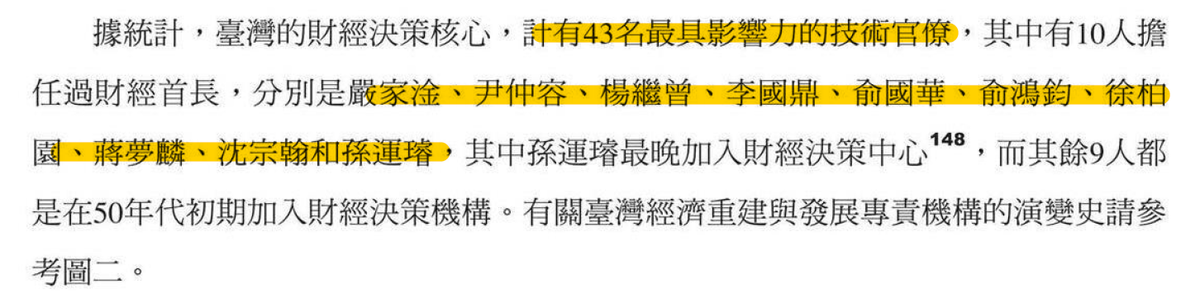
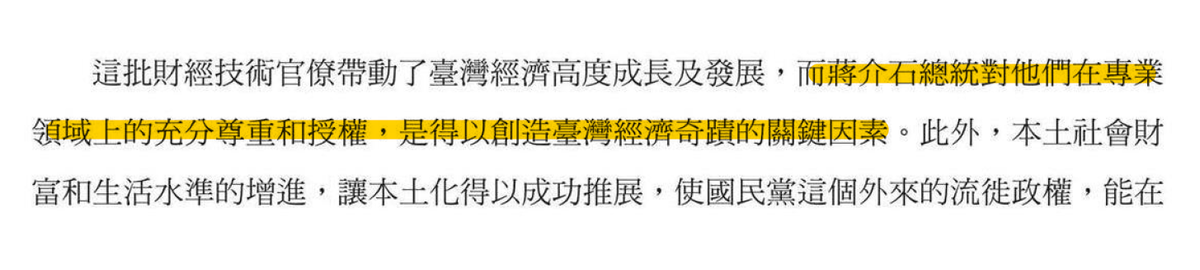
When implemented on Taiwan, his ideas produced an economic miracle.Though he received American economic aid through 1965, the amounts were so small that they cannot account for the country’s explosive economic growth. Economic statistics can never capture the tragedy that the Communist victory was for the Chinese people, but they do make some important points.The Communists collectivized agricultural production, and today the mainland produces less rice per capita than it did before the revolution. Chiang paid the landlords for their land and distributed it to the peasantry. The former landlords invested much of their money in industry while the government encouraged foreign investment. Today, Taiwan has a per capita income five times as great as that of the mainland. And the eighteen million Chinese on Formosa export about fifty percent more than the one billion on the mainland.
Mao sought to erase the past while Chiang sought to build upon it. In victory Mao simplified the characters of the written Chinese language, not only to facilitate his literacy campaign, but also to destroy the history that each of the complex characters encapsulated. In defeat Chiang made room in the refugee flotilla for nearly 400,000 pieces of ancient Chinese art, even as many loyal aides and soldiers remained on the mainland.
In their personal habits Chiang and Mao were a study in contrasts. Everything about Chiang was orderly—his dress, his office, his home. He was a disciplined, organized individual in every way. The adjectives tidy and neat do not overstate the impression he gave. Mao was the exact opposite. His study was littered with books and papers. If the test of a good executive is the cleanliness of his desk, he flunked. Mao was as disorganized as Chiang was organized and as undisciplined as Chiang was disciplined. The adjectives unkempt and sloppy would not overstate his appearance.
Chiang was a man of action who had been right so many times in his turbulent career that he developed an absolute faith in his own judgment. He was fond of reading the Confucian philosopher Wang Yang-ming, who stated that “to know and yet not to do is in fact not to know.”
Not even the debacle of 1949 could shake Chiang’s self-confidence. It was only another temporary setback to him. Every time I saw him, he talked of reconquering the mainland. And even when some of his associates had given up hope, he never lost faith.
The name he chose for himself, Kai-shek, translates as “immovable stone,” and in light of his temperament it was a most appropriate choice. I greatly admired his resolution. He never believed in bowing to the “inevitable” simply because it seemed inevitable. There are always those who will tell a public figure that his goals are impossible to achieve. They lack creative vision. Too often they consider something to be impossible just because it has never been done before. Chiang understood this. As he once wrote, “I have always been surrounded and sometimes overpowered by enemies. But I know how to endure.”
Notwithstanding his tenacity, Chiang had his faults, but a tragedy like the fall of China is never one man’s fault. Chiang was a brilliant political and military tactician, but his “by the book” rigidity made him a mediocre strategist.
The contrast between Madame Chiang and Jiang Qing, Mao’s fourth wife, was even more striking than that between Chiang and Mao.
Madame Chiang was civilized, beautifully groomed, very feminine, yet very strong. Jiang Qing was tough, humorless, totally unfeminine, the ideal prototype of the sexless,fanatical Communist woman. Whittaker Chambers once told me, “When you meet a Communist couple, you will usually find that the wife is the red hot of the two.” This was certainly true as far as Jiang Qing was concerned. I have never met a more cold, graceless person.
I first met with Chiang Kai-shek, the third great leader of China’s twentieth century, in 1953. I stayed in touch with him as Vice President and as a private citizen, and we formed a personal friendship that I valued greatly. That is why the rapprochement with Peking was such a profoundly wrenching personal experience for me.



 ;这个盘踞在大陆的乌托邦,必会如他预言最终被彻底埋葬,历史终究会完全证明他的高瞻远瞩。